
Nationwide reach, real buyer demand
Your calls are priced against a premium network of buyers competing for home services inventory. Competition between them is what lifts your earnings.
See where you can earn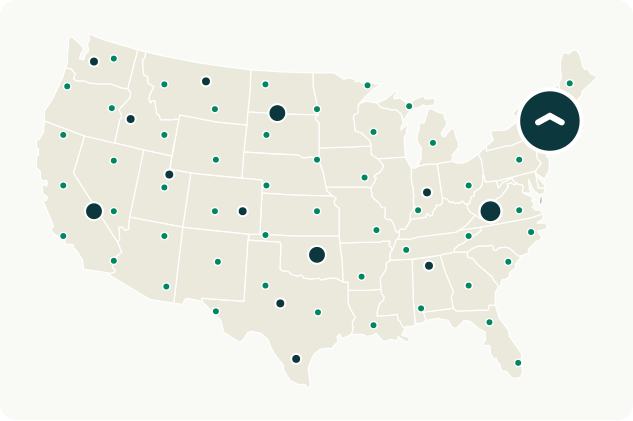
Already driving home services traffic that rings the phone? Polyares plugs your calls into a premium network of buyers paying top-of-market rates.
Apply to start earningMost publishers run both. Add form leads to the same account and earn on the visitors who never pick up the phone.
The network behind the call
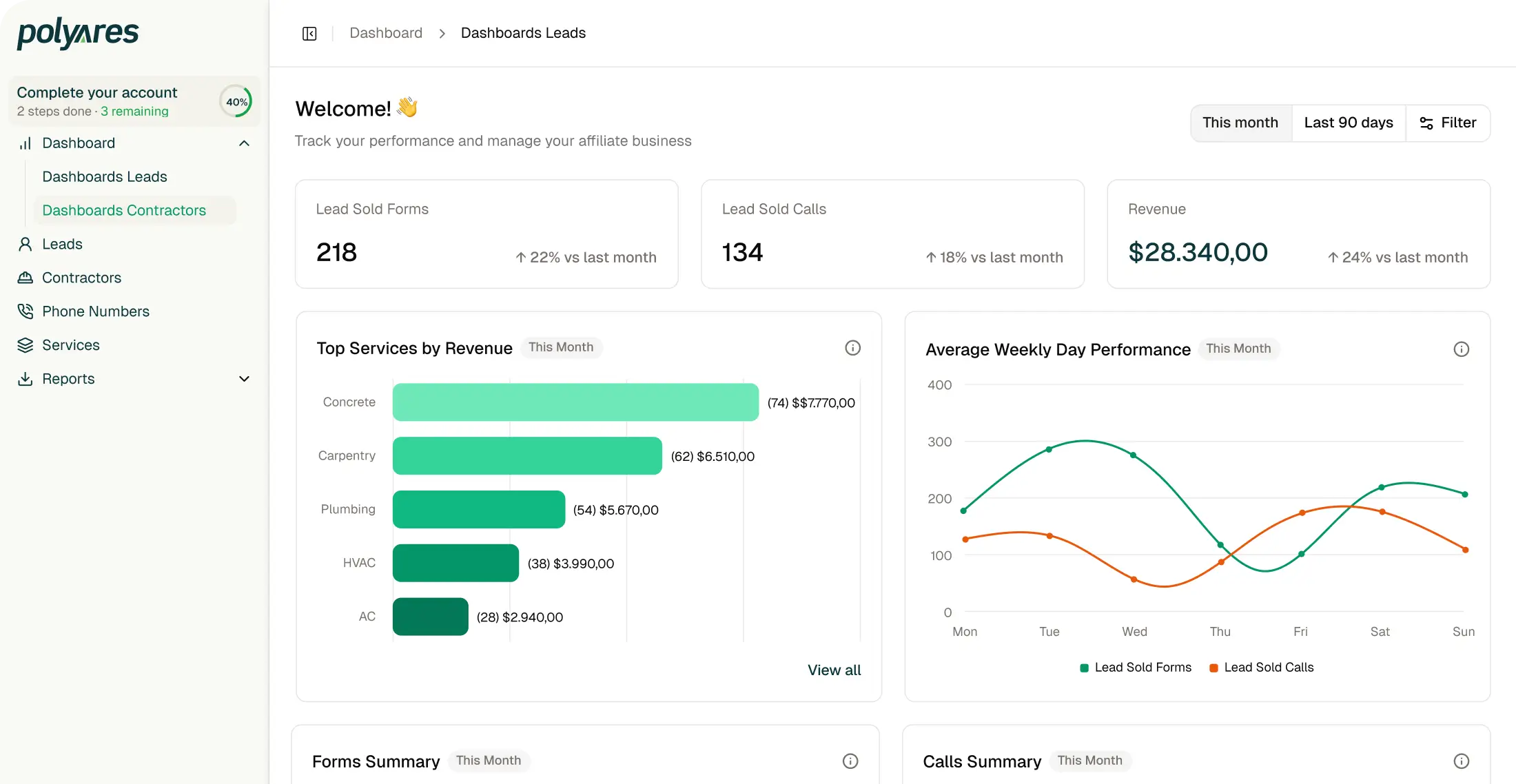
15+
years in home services lead gen
100,000+
leads / month
50
states covered
40+
home service categories
This is for you if you already have the traffic. You do not need to change what you run. You need somewhere better for it to land.
Your calls are priced against a premium network of buyers competing for home services inventory. Competition between them is what lifts your earnings.
See where you can earnOur own system qualifies and routes every call in real time, so the traffic you send actually converts. You see which side of the billable line every call lands on.
What you get paid for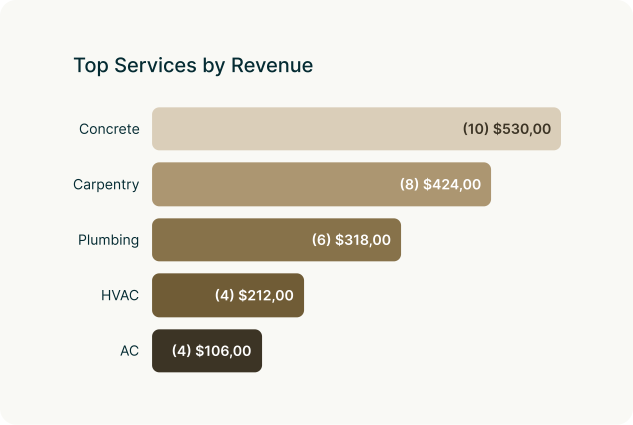
A branded tracked number per campaign, per placement, per page. Or full API and ping post if you run network volume.
How you go live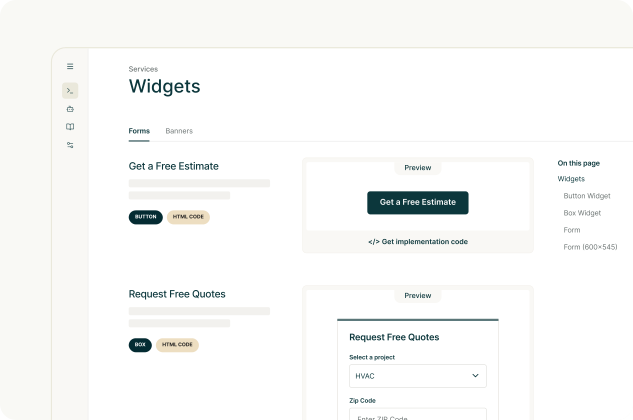
You earn on billable calls only, at a rate that moves with the market rather than a number fixed once and left alone.
The call connects, holds past the category duration threshold, and the caller is a homeowner or decision-maker with a real service need in a covered category and area.
Hang-ups before the threshold. Wrong category. Out of area. Duplicates inside the dedup window. Existing customers calling about scheduled work. Solicitation and misdial.
Category, geography, competition, and timing. Emergency and high-ticket work pays above routine work. Rates are set at the state and metro level and can differ by ZIP. The more buyers bidding on your category and area, the higher your floor, and after-hours emergency windows price differently than business hours. A call is also priced above a form lead, because the homeowner is already on the line, and on approval you get your category rates in writing.
Your payout per call is only half the story. The other half is how many of your calls clear the threshold. Move both and see what a call is really worth to you.
Your assumptions. Nothing here is a Polyares figure.
The share of the calls you send that hold past the duration threshold and clear. This is the number most publishers never see per call.
Payout is dynamic. It moves with category, geography, call quality and live buyer demand. Set your own estimate, or ask us for the rates in your categories.
Your estimated monthly earnings
$30,000
Roughly $360,000 a year at these assumptions.
Earned per call sent
$15.00
Billable calls / mo
1,200
Earned per call sent is the number worth comparing across networks, because it already accounts for what does not clear. A higher advertised payout on a lower billable rate can pay you less. This estimator uses only the numbers you entered. It is not a quote or a guarantee.
40+ home service categories in all 50 states. These 20 carry the deepest buyer competition right now.
Tell us your categories and your states, and we tell you where the demand is strong, where it is thin, and where it is growing. You get that before you build a campaign, so you never spend media dollars where the calls will not sell.
Apply and see where my calls sellEvery call carries its duration, disposition, and billable status in your dashboard, so there is no monthly statement to reverse-engineer. Frequency, net terms, methods, and the minimum threshold are stated in full in the publisher agreement, which you read before you sign.
Shaved calls and stretched payment terms are the two things publishers get burned by. Both are visible here, per call and per payment.
A dispute must be specific and against the billable criteria. It is reviewed against the call record and recording inside a fixed window, with the outcome shown on the call itself.
You do not have to move your volume to find out whether this works. One category in one state, on one number, is enough to get a real answer.
Your traffic sources, your categories, your states, your monthly volume.
A partner manager reviews your sources and sends your category rates in writing.
One category, one or two states, a single tracked number provisioned for you.
Audit your billable call rate in the dashboard against your own media numbers, then scale.
You can test this without touching what you run today. Provision one tracked number here and keep every other number where it is. One category, one state, and the billable rate in your dashboard is the only argument that matters.
Not every homeowner picks up the phone. The visitors who never call will fill in a form, and on most home services pages they are the majority. Both are inventory here, in the same account, with no additional media spend. Publishers who run both do not choose which visitor is worth monetizing; they monetize the page. Ask your partner manager to switch on form inventory for the categories and states you already run.
Accept rates, a reason code on every rejected lead, and the levers that move revenue per session on form traffic.
See the pay per lead programThat is the only sensible way to do it, and it is how we prefer to start. One category, one or two states, a single number. Audit your billable call rate in the dashboard against your own media data, then scale on your numbers, not on ours.
Yes. Provision one number here and leave every other number where it is. Compare the billable rate in your dashboard against what your current network reports, and move as much or as little as that comparison justifies.
There is no single number, and the rate is not fixed. Your payout tracks the rate for that category and geography, and rates move with capacity, season and competition. You get your category rates in writing at approval. A fixed rate is negotiable on committed volume, and it will price below the dynamic rate, because you are moving the risk to us.
Frequency, net terms, methods, and the minimum threshold are stated in full in the publisher agreement, and you read all of it before you sign.
Terms are in the contract, not on a portal page. On sustained volume, faster terms are negotiable. Ask before you scale, not after your first invoice.
The call connects, holds past the category duration threshold, and the caller is a homeowner or decision-maker with a real service need in a covered category and geography. Not billable: pre-threshold hang-ups, wrong category, out of area, duplicates inside the dedup window, existing customers calling about scheduled work, solicitations, and misdials. Each call shows its duration and disposition, so you see which bucket it fell into.
It varies by category and by buyer, because qualifying intent takes longer in some categories. Locksmith and appliance repair qualify fast. Roofing and insulation do not. Your exact thresholds are listed per category in your account.
Incentivized calls. Robocalls, autodialers and ringless voicemail. Outbound without documented consent. SMS or email to non-opted-in lists. Trademark bidding on Polyares or any buyer. Cloaked traffic, forced pops, toolbar and adware without prior written approval. Third-party call center transfers without prior approval. Creative impersonating a contractor, manufacturer, warranty provider, utility or government program. Anything not TCPA compliant in the state of origin.
Search, click to call display, paid social with call CTAs, and owned directory or content inventory are all standard here. Bring a new source to your manager before you scale it: we would rather reject it at approval than claw back a month of your revenue.
Clean traffic. Buyers pay a premium because the calls hold up, so the caller has to be the homeowner or the decision maker, with a real service need, inside the covered area, in the category the call was routed as. Accurate category intent matters most: a plumbing call routed as HVAC is a non billable call and a damaged buyer relationship.
Yes, named, from approval, and reachable by phone. Routing and qualification run on our own platform, so when a category starts misrouting the fix happens here rather than on a vendor roadmap.
A dispute has to be specific and against the billable criteria. It is reviewed against the call record and the recording, inside a fixed window, and you see the outcome and the reason on the call in your dashboard.
It is a human review, mostly about your traffic sources and your compliance posture. Come with your sources, geos, categories and monthly call volume and it moves faster. If you run for another network today, say so. It helps rather than hurts.
Not blind. If there is no active buyer for that category and state, the ping returns no bid and you should not be spending media there. We tell you where coverage is thin before you build a campaign. If you already have volume in an uncovered state, send us the numbers. Recruiting for a publisher who is already generating is normal work here.
Yes. Full API and ping post, rate transparency at the category level, and no requirement to disclose your sub publishers. Compliance responsibility for them stays with you, and that is in the agreement.
Nothing. There is no fee to apply and no fee to run. You earn on billable calls.
Free to join. Tell us your traffic sources, your categories, and your states, and a partner manager comes back with your category rates in writing. You keep running whatever you run today.